
A few months back, my cousin forwarded me a WhatsApp message with the NADRA logo slapped right at the top. “NADRA Hiring 500+ Staff — No Test, No Interview — Apply Now. Refundable Registration Fee Rs. 1,500.” She’d already opened her gallery to send a photo of her CNIC.
I made her wait five minutes. We pulled up the real NADRA website together and searched for that exact ad. Nothing. It didn’t exist anywhere official. That “job” was fake, and that fee was never coming back once she sent it.
More Jobs: Election Commission of Pakistan Jobs 2026 — Online Apply | ECP Jobs 2026 | How to Apply
That mix-up is basically why this guide exists. Every few weeks, someone I know asks me to sanity-check a NADRA job post before they apply, because the real process and the scam version look uncomfortably similar if you’ve never actually been through either one. So let’s go through how it actually works, step by step, without the recycled fluff most job sites copy from each other.
First, Let’s Clear Up What You’re Actually Looking At
NADRA stands for the National Database and Registration Authority. Most people know it as “the CNIC people” — they issue your national ID card, family registration certificates, NICOP, and a handful of other identity documents.
Quick side note, because it confuses people: NADRA also has the PakID app and the Pak Identity Portal, which are for applying for those ID documents, not for jobs. If someone tells you “NADRA has an app, just use that to apply for the job,” they’ve mixed up two completely different products. Keep that separate in your head.
When you search “NADRA Jobs,” you’ll also run into ads from NADRA Technologies Limited, usually shortened to NTL. It’s a related entity that handles more of the technical and IT side — verification systems, biometric services, that kind of thing. Both NADRA and NTL post real, legitimate job ads, sometimes on slightly different-looking portals. It doesn’t change how you apply, but it explains why the letterhead sometimes looks a bit different from what you expected.
Where the Real Job Postings Actually Show Up
Here’s the part that trips people up the most: there is no single “NADRA Jobs 2026” form that opens in January and closes in December.
NADRA hires constantly, in small batches, spread across different cities and departments. In the space of a few months this year alone, ads have gone up for IT roles in Gilgit-Baltistan, data entry walk-in tests in Sindh and Punjab, and technical postings in Islamabad — each with its own separate deadline, sometimes weeks apart.
So “the latest NADRA careers” isn’t one page sitting somewhere waiting for you. It’s whatever happens to be open right now, in whatever city and department matches your qualifications.
The safest starting point is the official site itself: nadra.gov.pk. On the homepage, there’s usually a “We Are Hiring” banner near the top. Click through that instead of typing in a portal link someone shared with you — I’ll explain exactly why that matters in a bit.
From there, you land on the careers portal, where current openings are listed with the post, city, and closing date attached.
Don’t ignore newspaper classifieds either. NADRA’s regional ads, especially walk-in test notices, are still regularly published in papers like Express before — or instead of — showing up prominently online. If you’re serious about this, it’s worth a glance at the classifieds every so often, not just a Google search.
The Two Very Different Ways NADRA Actually Hires
Something most guides skip entirely: NADRA doesn’t hire everyone the same way. There are essentially two separate tracks.
Track one is the online application route. This covers the more office-based and technical roles — Assistant Director, Deputy Director, System Administrator, Network Engineer, Java Developer, Deputy Superintendent (Technician), and similar posts. You apply entirely through the careers portal. There’s no need to show up anywhere until you’re actually shortlisted.
Track two is the walk-in test route. This is mostly for local, entry-level roles like Junior Executive (usually the Data Entry Operator post), Naib Qasid, Driver, Security Guard, and Scanning Operator. These are frequently restricted to residents of a specific tehsil or district, checked against your CNIC and domicile. You show up in person, sit a written and/or typing test on the spot, and if you clear it, you’re often interviewed within a day or two.
Knowing which track your target role falls under changes how you prepare. Track one is mostly about a clean online application and patience while you wait. Track two is about showing up on the right day, in the right city, with the right paperwork, ready to be tested cold.
Applying Online, Step by Step (Track One)
Here’s roughly how the online route goes, in order:
1. Start from nadra.gov.pk, not a forwarded link. Follow the “We Are Hiring” banner through to the careers portal yourself.
2. Open the actual advertisement PDF, not just the job title. This is where eligibility, domicile requirements, age limit, and the closing date actually live — and it’s the single most skipped step I see. People apply for posts they were never eligible for because they only read the headline on a job aggregator site.
3. Create your account with an email and phone number you genuinely check. Sounds obvious, but a surprising number of people register with an old email they haven’t opened in a year, then wonder why they never heard back after being shortlisted.
4. Fill out the form completely and honestly. NADRA is direct about this in its advertisements — giving false information anywhere in the application gets you disqualified, no exceptions and no warnings.
5. Get your documents ready and upload them properly. You’ll typically need your CNIC, domicile certificate, educational certificates attested by HEC or your board, a recent photograph, your CV, experience letters where relevant, and a No Objection Certificate if you’re already employed in government or semi-government service. Scan everything properly lit and right-side up — a blurry photo taken on a phone at 2 a.m. is a quiet, common reason applications get passed over.
6. Submit a couple of days before the deadline, not on it. Government portals in Pakistan tend to slow down badly in the final hours before a closing date, when everyone logs in at once. I’ve watched this happen often enough that “don’t wait until the last day” has basically become a personal rule I repeat to everyone.
7. Track your status through your portal dashboard. If you’re shortlisted, that’s usually where you’ll see it first, alongside an email or SMS notification.
One more thing worth doing early: if your degree needs HEC attestation and it isn’t attested yet, start that process well before you plan to apply. Attestation alone can take days to weeks, and it’s a bad surprise to discover on the day a deadline closes.
Applying Through a Walk-In Test (Track Two)
If your target role is the walk-in kind, the process looks noticeably different:
1. Confirm the domicile requirement before doing anything else. These ads are usually tehsil-specific. Turning up for a test you’re not actually eligible for, based on your CNIC address, is one of the most common — and most avoidable — wasted trips people make.
2. Note the exact venue, date, and reporting time. These tests are typically held at a NADRA Regional Head Office, not the headquarters in Islamabad, so double-check which city you’re actually meant to be in.
3. Bring original documents, not photocopies. The advertisements are blunt about this — incomplete sets or photocopies aren’t accepted at the door, and there’s no exception made on the day.
4. Leave your phone and smartwatch outside. Mobile phones and smartwatches are generally not allowed inside the test hall. Switching it to silent and keeping it in your pocket isn’t the same as leaving it behind, and it’s treated that way.
5. Prepare properly for the test itself. The written portion usually covers general knowledge, basic English and Urdu, and some reasoning-style multiple choice questions. For data entry and Junior Executive roles, there’s also a typing test — some ads specify a speed cutoff around 30 words per minute, though the exact number is always in your specific advertisement, not a fixed rule. If you’re mostly used to typing on a phone keyboard, that’s worth noticing now rather than at the test. Spending fifteen minutes a day on a free typing test site — something like 10FastFingers — for a couple of weeks beforehand makes a genuinely noticeable difference in both speed and accuracy on a physical keyboard.
6. Stick around after the test — the interview often follows within a day or so, sometimes the same day. Dress like you’re already expecting to be called in, because you might be, right after the written portion is marked.
7. If you’re selected, expect a medical fitness certificate and a character certificate as part of onboarding, along with a probation period that’s usually six months.
A Realistic Walkthrough, Start to Finish
To make all of this less abstract, here’s roughly what it looks like for someone applying to a Junior Executive post — say, an intermediate-pass candidate in their early twenties, applying from their home district.
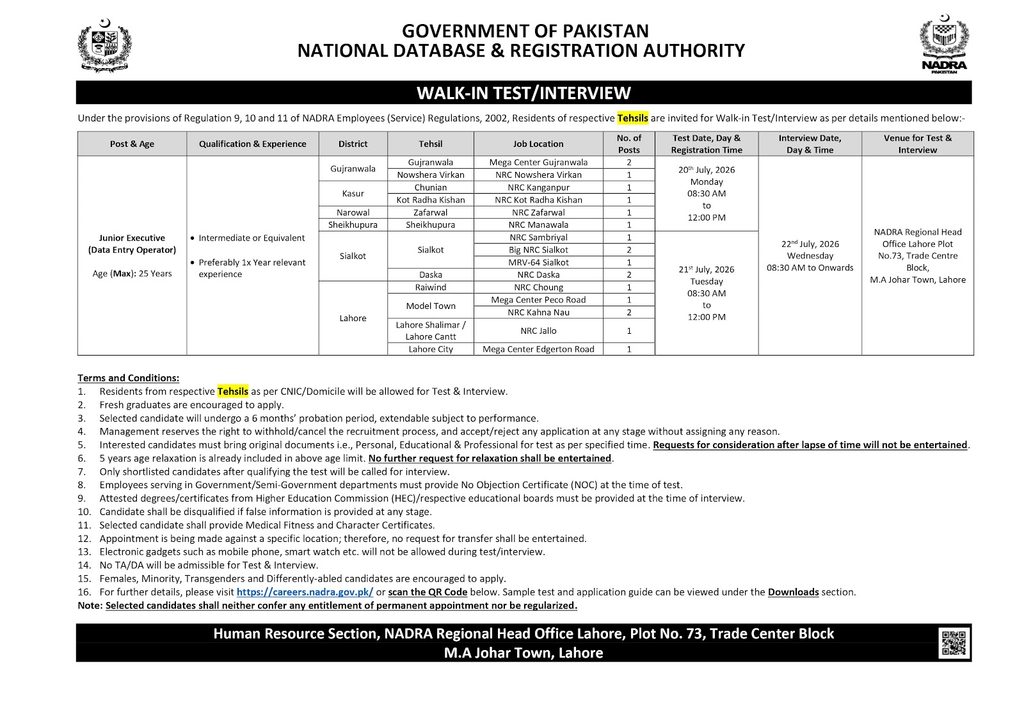
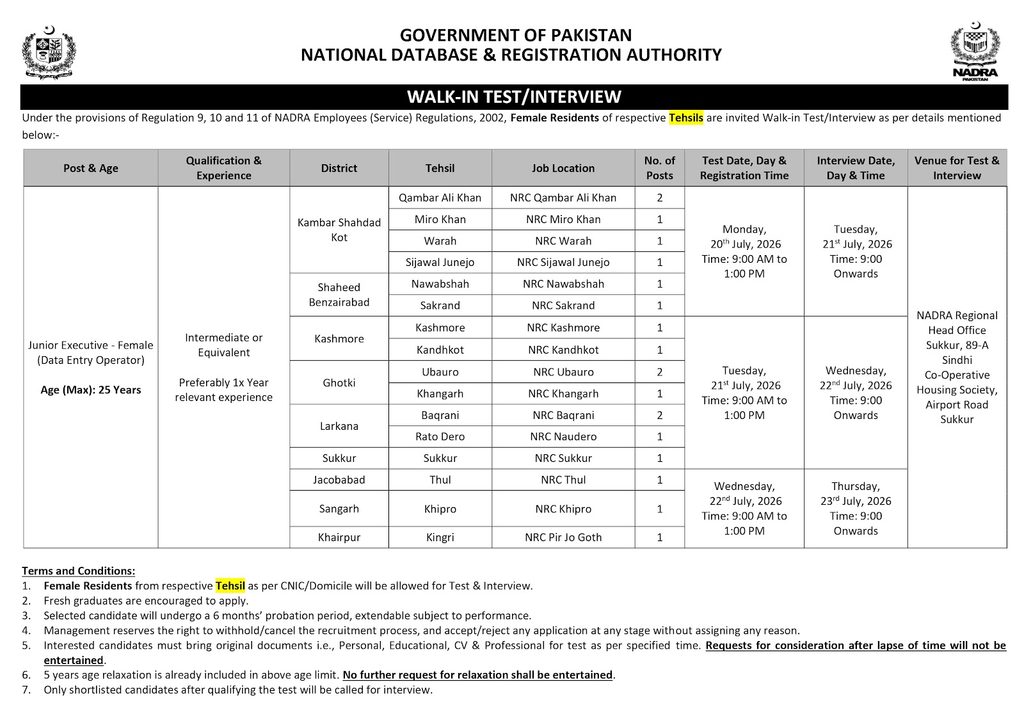
They see a walk-in test notice for their tehsil, posted both on the NADRA site and in a local paper, with a test date about three weeks out. First move: check the domicile line carefully to confirm they actually qualify, not just skim the job title. Next, they start pulling together their original CNIC, domicile certificate, and attested intermediate certificate, since those take a few days to gather if anything’s missing.
For the two weeks before the test, they spend a bit of time most evenings on typing practice, since the DEO role includes a typing component and they mostly type on a phone otherwise. On test day, they arrive early at the Regional Head Office with a folder of originals, no phone in their pocket, and sit the written and typing test. They clear it, get called in for an interview that same afternoon, and a couple of weeks later get a call to start on a fixed-term contract with a six-month probation attached.
Nothing about that path involves paying anyone, being contacted first over WhatsApp, or skipping the test. If any of those three things show up instead, that’s the version to be suspicious of.
Common Mistakes People Make (Beyond Falling for Scams)
Outside of scams specifically, these are the avoidable slip-ups I see most often:
- Applying to a walk-in post outside their own tehsil, assuming it’ll be fine anyway. It usually isn’t, and it’s an entirely avoidable wasted trip.
- Reading only the job title on an aggregator site, not the actual advertisement PDF, and missing the age limit or domicile clause.
- Registering with an email they never check, then missing the shortlist notification entirely.
- Assuming the age relaxation is extra, when many ads state the general relaxation is already built into the published age limit — read that line twice before ruling yourself out or in.
- Treating a contract role as an automatic permanent government job. It isn’t, at least not immediately — extensions and longer-term placement happen, but they’re earned, not guaranteed.
- Skipping typing practice for a Data Entry Operator role and assuming general computer familiarity is enough.
- Forgetting the NOC if they’re already working in a government or semi-government job, which several advertisements explicitly require at test time.
- Dressing too casually for the interview, on the assumption that an entry-level post means a casual conversation. It’s still a formal interview.
The Scam Pattern to Actually Watch For
Circling back to where this started, because it matters more than any of the steps above: fake NADRA job posts are common enough that NADRA itself has publicly warned people about impersonator websites and social media pages using its name.
The pattern is almost always the same. A message or post that looks official, a promise that conveniently skips the parts that make the real process slow and annoying — no test, guaranteed selection, immediate joining — and a request for some kind of “processing” or “registration” fee.
Here’s the boring, honest truth: the real process never skips the annoying parts. There’s a test or structured screening for nearly every entry-level post, a formal interview, document verification, and — this is the part worth remembering — no fee to apply. Across every genuine advertisement out there, none of them ask for any payment just to submit an application.
A few habits keep you safe here:
- Start from nadra.gov.pk yourself, typed in by hand, not tapped from a forwarded message.
- Check that the URL actually ends in .gov.pk before you enter any personal information.
- Never send money to “confirm,” “process,” or “fast-track” an application. That request alone is the scam.
- If something feels off, call NADRA’s general public helpline — 1777, or +92-51-111-786-100 — and ask directly before you act on anything.
That last one is exactly what stopped my cousin’s fifteen hundred rupees from disappearing into someone else’s account.
What the Job Is Actually Like Once You’re In
A few things about the job itself that don’t always come through in a listing.
NADRA roles, like a lot of government-linked hiring in Pakistan, typically start on a contract rather than a permanent appointment. Contracts commonly run one to three years, and the advertisements are upfront that they don’t automatically convert into permanent, regularized positions, even after an extension.
In practice, that means strong performers — particularly in technical and directorate-level roles — do get considered for extensions, and sometimes longer-term placement with benefits like medical coverage. But it’s earned through performance, not handed out automatically, so it’s worth going in with that expectation set correctly.
Pay varies a lot depending on post and grade. Figures floating around range from roughly PKR 40,000 for entry-level data entry work up to well over PKR 100,000 for senior technical and directorate posts, but I’d genuinely take any specific number you find on a random job aggregator with a pinch of salt — including the ones in this article. The actual figure is always stated in that specific advertisement, not on a general guide like this one.
On a more positive note, NADRA is consistently explicit about inclusive hiring. Ads regularly mention reserved consideration for women, transgender candidates, and persons with disabilities, and actively encourage applications across the board rather than from one narrow group.
Quick Answers to What People Actually Ask
Is there a fee to apply? No, not through the official process. Anyone asking you to pay to apply, or to “guarantee” a slot, is running a scam, not offering a shortcut.
Can freshers apply? Yes. Entry-level posts like Junior Executive generally don’t require prior experience, though basic computer or typing skills genuinely help at the test stage.
Can I apply from any city for any post? Depends on the track. Online, corporate-style roles are usually open nationwide. Walk-in, regional roles are frequently restricted to a specific tehsil or district based on your domicile.
Is it a permanent government job from day one? No. It starts contract-based with a probation period, with extension or longer-term placement possible based on performance, but not guaranteed upfront.
Should I apply through NADRA or NADRA Technologies Limited? Whichever the specific advertisement names. They’re related but separate entities — just follow the portal link given in that particular ad rather than assuming one covers the other.
Final Thoughts
If there’s one thing worth taking from all of this, it’s that “NADRA Jobs 2026” was never a single event you’re either on time for or you’ve missed. It’s an ongoing, rolling thing, with new ads showing up all year, in different cities, for different posts.
So the actual strategy isn’t panic-applying to the first message that lands in your WhatsApp. It’s keeping your documents attested and ready ahead of time, checking nadra.gov.pk every so often instead of relying on whatever gets forwarded to you, reading the full advertisement before you get attached to a job title, and treating any request for money upfront as an immediate, non-negotiable red flag.
Do that, and you’re already ahead of most people who apply.


Pingback: Pakistan Digital Authority Jobs 2026 | PDA Jobs 2026 | Latest Government Jobs | Apply Online - GFTrackAPK